Cutting Cement Mill Energy Costs with Agentic AI

Executive Summary
Electricity is one of the largest controllable costs in cement grinding, and it has two levers: when the mills run, and how much energy each tonne needs. This article shows how Juna Factory OS works both on one shared plant model.
Running mills in low-price hours sounds simple. In practice, silo capacity, delivery commitments, minimum run lengths, changeovers, shared conveyors and electrical limits decide which hours can move at all. The agentic planner schedules production against electricity prices inside these limits, projects silo levels forward, and keeps committed runs in place when the plan updates. A hedge does not remove the opportunity: where surplus power can be resold, every contracted MWh burned in an expensive hour gives up its resale value.
On the second lever, AI agents build analysis tools directly on the plant model, such as specific energy consumption per production run, mill and product. Engineers see where energy per tonne is drifting and why, and confirmed improvements feed straight back into the schedule.
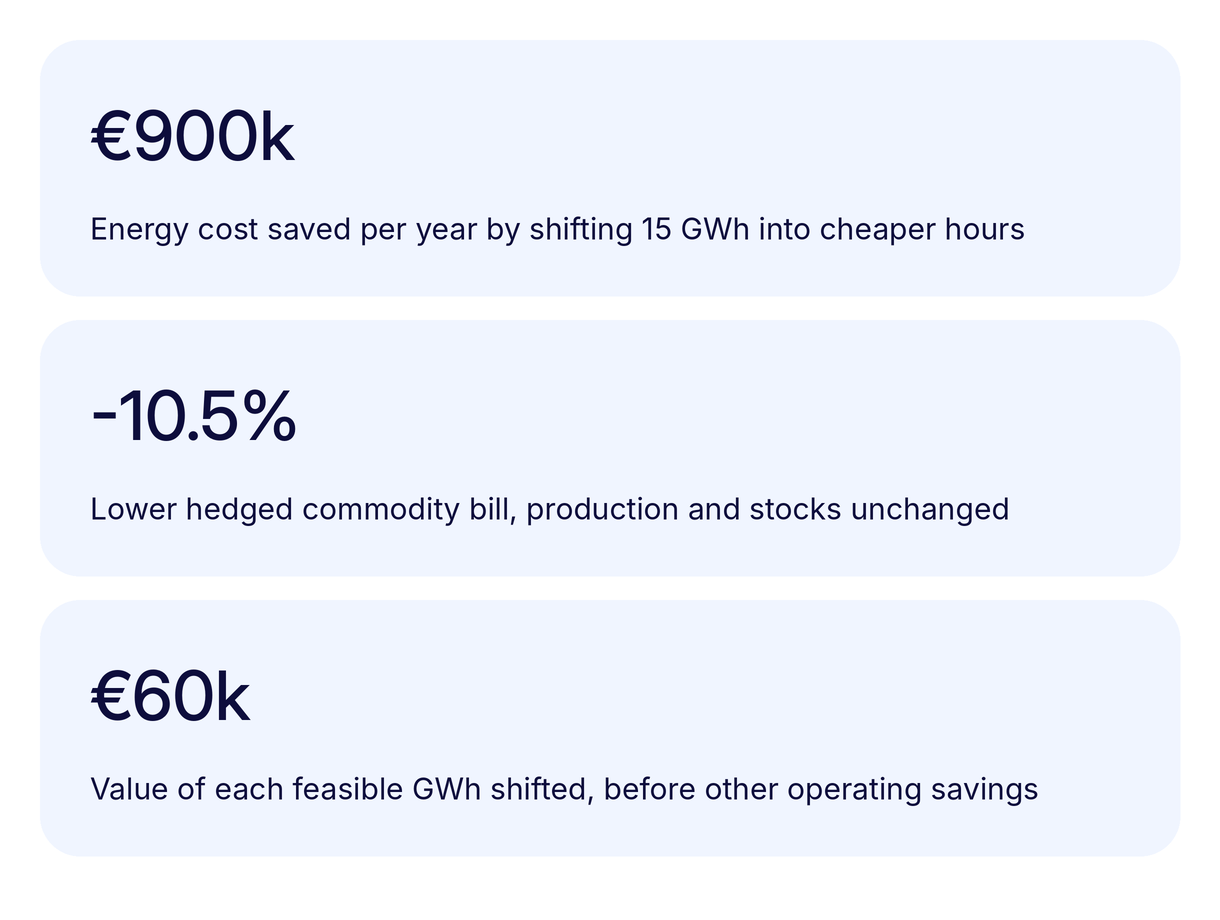
The worked example in the article: a plant consuming 100 GWh a year, with 70 GWh hedged at €80/MWh. Moving 15 GWh from €140/MWh hours into €80/MWh hours saves €900,000 a year, a 10.5% reduction of the hedged commodity bill, with production, closing stocks and the hedge unchanged. Each feasible GWh shifted is worth €60,000, before further operating cost savings.
Worked example, 100 GWh plant
What Changed
Juna built a hybrid digital twin of the spray dryer, integrating:
- Heat and mass transfer physics
- Historical production data
- Real-time sensor signals
- Operator knowledge and constraints
On top of this twin, reinforcement learning agents were trained in simulation to learn optimal control strategies before deployment. Once live, the AI Co-Pilot:
- Predicts process behavior ahead of time
- Recommends optimal setpoints (Exhaust Air Temp, Main Air Temp, Fluid Bed Temp)
- Balances moisture precision, throughput, and energy simultaneously
- Continuously adapts to product variation, ambient conditions, and equipment drift
The result is a control system that learns from every batch, reduces operator variability, and runs the spray dryer closer to its true physical optimum — safely, transparently, and autonomously.
Download the full case study
Other case studies
 case-study
01 Jun
Agentic Scheduling: How a Carbon Black Producer Increased Contribution Margin by €5.3M per Year
 case-study
01 Jun
Agentic Process Optimisation: How a Leading Dairy Manufacturer Increased Profits by €1.5M per Year
 case-study
01 Jan
Coming Soon: Fortune500 Paper Manufacturer Improves Throughput and Reduces Scrap with Agentic Process Optimisation