Agentic Scheduling: How a Carbon Black Producer Increased Contribution Margin by €5.3M per Year

Executive Summary
A leading German carbon black manufacturer faced extreme scheduling complexity across six furnaces, more than 30 product grades, fluctuating oil blends, silo constraints, emissions limits, and tight logistics windows.
Manual and Excel-based planning required up to a full day per schedule, 40% of orders had to be re-planned, and optimization beyond feasibility was practically impossible.
Juna AI deployed its Agentic Production Scheduling system — combining a real-world digital twin with hybrid AI optimization — to automate and continuously improve production planning.
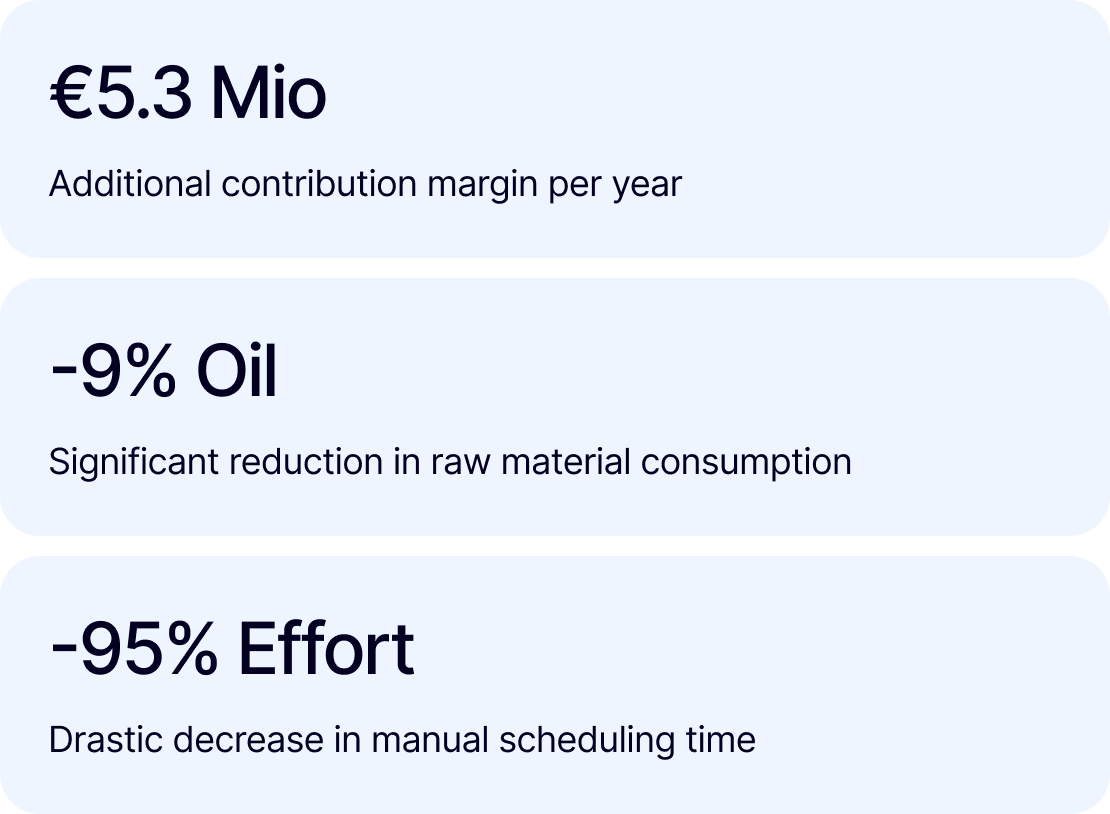
The result: over €100,000 in additional contribution margin per week, drastically reduced planning effort, and a shift of production scheduling from daily firefighting to a strategic capability.
Impact
What Changed
Juna built a live digital twin integrating ERP data, real-time production signals, silo levels, utility constraints, logistics commitments, and sustainability metrics into a single decision model.
On top of this model, Juna’s hybrid optimization engine combines mathematical solvers (MIP) with AI-based learning to:
- Respect hundreds of operational constraints
- Balance cost, emissions, and delivery reliability
- Re-optimize automatically when conditions change
- Deliver feasible, cost-efficient schedules in under one minute
The result is a scheduling system that continuously adapts to downtime, urgent orders, and supply fluctuations: turning production planning from a bottleneck into a competitive advantage.
Download the full case study
Other case studies
 case-study
01 Jan
Coming Soon: Fortune500 Paper Manufacturer Improves Throughput and Reduces Scrap with Agentic Process Optimisation
case-study
01 Jan
Coming Soon: Fortune500 Paper Manufacturer Improves Throughput and Reduces Scrap with Agentic Process Optimisation
 case-study
01 Jan
Coming Soon: Cement Manufacturer Increases Stability, Reduces Downtime, and Cuts Energy Consumption with Juna
case-study
01 Jan
Coming Soon: Cement Manufacturer Increases Stability, Reduces Downtime, and Cuts Energy Consumption with Juna
 case-study
01 Jan
Coming Soon: Global Food Manufacturer Improves OEE and Reduces Energy Consumption with Juna
case-study
01 Jan
Coming Soon: Global Food Manufacturer Improves OEE and Reduces Energy Consumption with Juna